
Shop
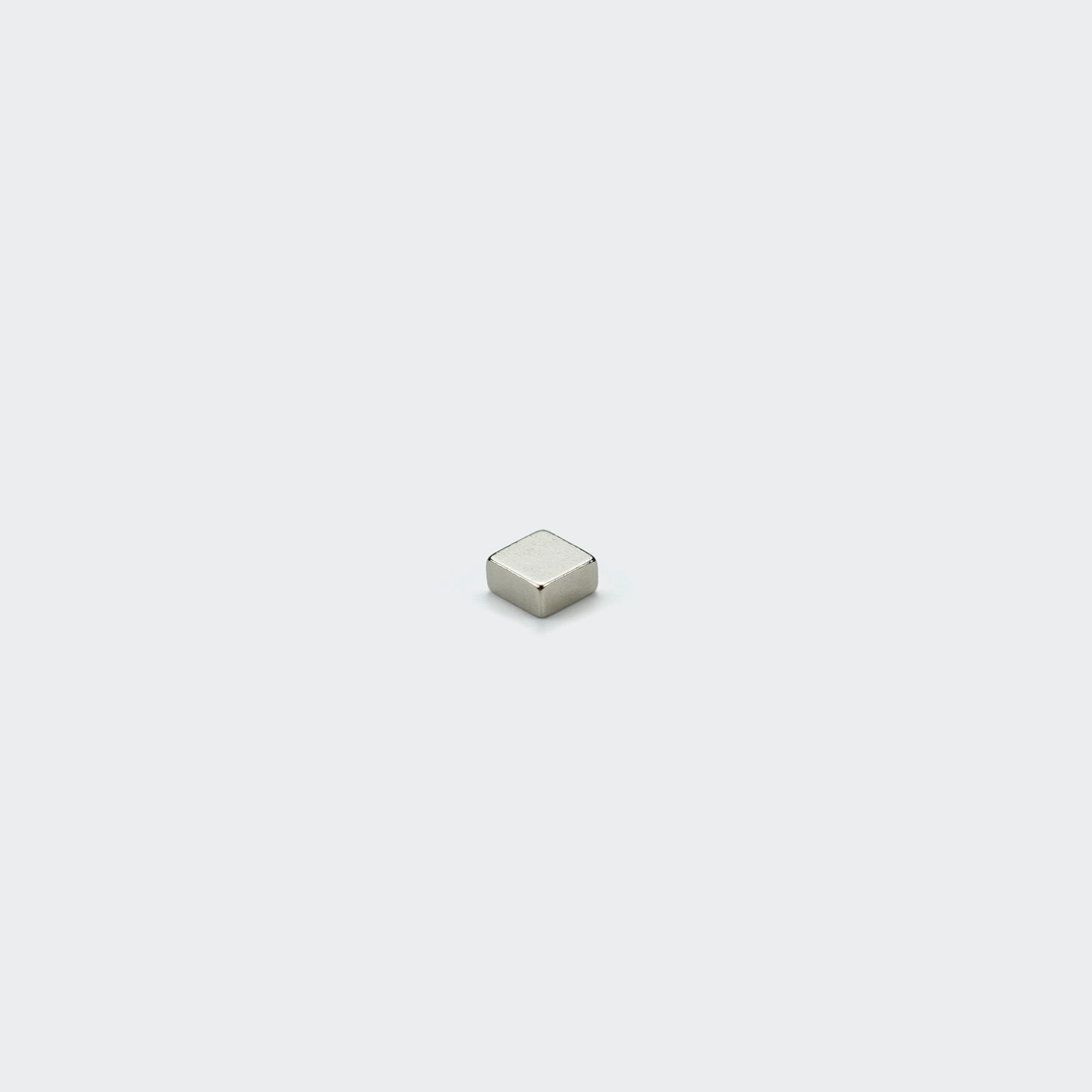

Tiny Square Magnets
$ 0.89
We offer custom small-scale Neodymium block magnets. The dimensions are down to 1mm × 1mm × 0.5mm (or smaller, depending on feasibility). These micro-scale magnets are commonly used in: – Miniature sensors, micro-motors, medical devices, hearing aids, microfluidic systems, electronics assemblies. – And precision instrumentation where magnetic force is required in a compact footprint. We typically produce blocks below approximately 3mm in any dimension using multi-wire slicing from larger sintered blocks. And then do plating or coating individually. Tolerances are typically ±0.05mm to ±0.1mm depending on size. Edge definition and coating coverage become limiting factors as dimensions decrease. Magnetization direction is typically through-thickness (shortest dimension). But can be specified through-length or through-width. This depends on geometry and application requirements. Standard nickel plating is typical, though uncoated, parylene-coated. Or epoxy-coated versions may be available depending on size and quantity. Handling, coating adhesion, and mechanical fragility increase significantly at sizes below 2mm. Minimum order quantities are typically higher for micro-scale magnets due to processing complexity. The Manufacturing Advantage: “Precision at Scale” 1. Multi-Wire Slicing Technology: Standard cutting saws destroy small magnets, causing edge chipping and fractures. Our Capability: – We utilize advanced multi-wire slicers (similar to semiconductor wafer processing) to cut these micro-blocks. The Benefit: – This results in chip-free edges and superior surface finish. – It is critical when the magnet is being placed onto a PCB or inside a watch movement. 2. Coating Integrity: Plating a 2mm magnet is technically difficult (they tend to stick together in the plating barrel). Our Capability: – We use specialized barrel-plating techniques. – It ensures 100% surface coverage without “sticking points” or missed spots. – This guarantees the magnet will not corrode, even in humid micro-environments. Grade Selection: Size vs. Strength At this size, volume is tiny. You need high grades to make it useful. Maximizing Performance in Micro Spaces: – With a volume of only 4mm³, standard N35 grade often provides insufficient flux. Recommendation: – For magnets this small, we strongly recommend upgrading to N48, N50, or N52. The Result: – Using N52 in this 2mm x 2mm size allows you to achieve the magnetic pull force of a much larger N35 magnet. – It saves valuable space in your housing. Handling & Packaging (The “Micro” Challenge) 1. Vacuum Tray Packing: We do not ship these in bulk bags (which turns them into a clump of magnetic dust). Our Standard: – Micro-magnets are aligned in plastic vacuum trays. – This allows for automated pick-and-place assembly or easy removal with tweezers. 2. Handling Advice: Tooling: – Always use Non-Magnetic Tweezers (Plastic, Ceramic, or Titanium). – Steel tweezers will make installation impossible as the magnet will jump to the tool. Applications Hall Effect Sensors: The trigger magnet inside smartphones, laptops, and TWS earbuds. Horology (Watchmaking): Micro-rotors or magnetic clasps in luxury watches. Medical Devices: Catheter guidance tips and implantable pumps. Micro-Switches: Reed switch actuators on PCBs. Ordering Guide: Specifying Micro-Parts To quote this accurately, please specify: 1). Dimensions: Length x Width x Thickness (in mm). 2). Tolerance: Is standard ±0.05mm okay, or do you need precision ±0.03mm? 3). Coating: (Parylene is highly recommended if this is for a medical device). 4). Direction of Magnetization: Through the 1mm thickness?