
Shop
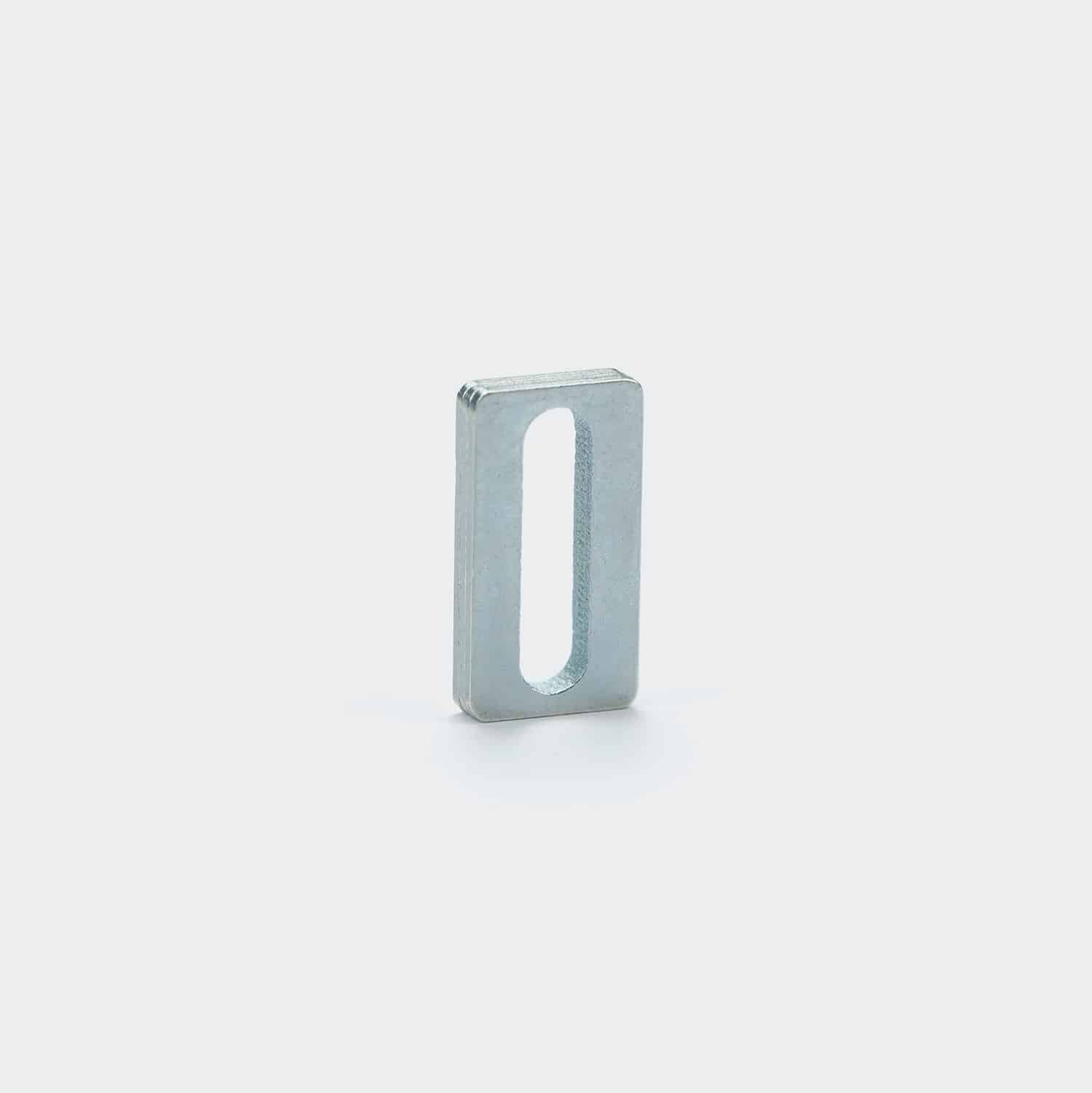

Slotted (Obround) Block
$ 0.89
We make custom Neodymium block magnets with a slotted (obround or stadium-shaped) through-hole. This feature allows linear positional adjustment along one axis. The elongated aperture permits the magnet to be mounted using a bolt or pin while retaining the ability to slide or adjust position during installation or calibration. This is useful in applications requiring alignment tolerance, such as sensor brackets, conveyor guides, adjustable latches, mounting fixtures, or positioning assemblies. The slot is typically machined after sintering using wire EDM, milling, or laser cutting, then coated or plated. Slot dimensional tolerance is typically ±0.1mm to ±0.2mm. But also depends on your magnet customization requirements. Coating the inner slot surfaces can be difficult. Uncoated slots or post-coating epoxy fill may be necessary. Minimum wall thickness around the slot is typically 1mm to 1.5mm to prevent cracking. Slot length is limited by magnet geometry. And structural integrity—length-to-width ratios above 3:1 may reduce magnet strength or increase fragility. The Engineering Logic: Why a Slot instead of a Hole? This explains the functional advantage to the buyer. 1. Positional Adjustment: The Problem: – Drilled holes require perfect alignment. – If your mounting plate is off by 1mm, a round-hole magnet won’t fit. The Solution: – The slot provides Linear Tolerance. – You can insert a screw, slide the magnet to the exact position required. – E.g., to trigger a Hall Effect sensor at the perfect distance, and then tighten the screw. 2. Pass-Through Utility: The Function: The elongated shape is perfect for passing Flat Ribbon Cables or flexible straps through the magnet. Such wires wouldn’t fit through a round hole. Manufacturing Method: Wire EDM You cannot drill a slot; it must be cut. This explains the precision. Precision Wire Cutting: To produce this internal geometry without cracking the brittle magnet, we use Wire EDM (Electrical Discharge Machining). No Tooling Cost: Because this is a CNC-programmed cut, we can produce custom slot lengths and widths without expensive molds. Inner Corner Radius: We ensure the ends of the slot are perfectly rounded (Full Radius) to reduce stress concentration points. Warning: Wall Thickness Look at the photo – the long side walls are thin. This is a risk. Structural Integrity: – The “webs” (the side walls parallel to the slot) are the weakest points. Torque Caution: – When mounting this with a screw, do not use a countersunk head (which forces the walls outward). – Use a Pan Head or Washer to distribute pressure. The “1.5mm Rule”: – We recommend maintaining a wall thickness of at least 1.5mm to 2mm on the sides. – If the wall is too thin, the magnet will snap when the screw is tightened. Surface Coatings Zinc (Zn): – The photo is Zinc – slightly blueish/matte. – Good for cost-effective adjustable brackets. Nickel (Ni-Cu-Ni): – Standard shiny finish. Epoxy: – Recommended if the magnet is used in outdoor adjustable latches. Applications Adjustable Sensor Targets: Sliding the magnet to calibrate the switching distance. Jigs & Fixtures: Work-holding stops that need to be moved for different part sizes. Cabinet Latches: Allowing the magnet to be adjusted forward/backward to ensure a flush door close. Cable Management: Passing a flat velcro strap through the slot. Ordering Guide: Critical Data To quote this, we need 4 dimensions: 1). Block Size: Length x Width x Thickness. 2). Slot Width: The narrow dimension of the hole (screw clearance). 3). Slot Length: The long dimension of the hole (travel distance). 4). Magnetization: Through Thickness?